
Osaka and Tokyo both offer extensive nightlife, but they reward different styles of travel. Central Osaka is comparatively compact: dinner in Namba, drinks in Shinsaibashi and a club near Amerikamura can fit into one evening without much transport. Tokyo offers far more districts and specialised venues, but crossing the city after dinner can consume time and make the last train a serious deadline.
The social atmosphere differs as well. Many Osaka nights begin with food and continue through informal bars, while Tokyo ranges from tiny neighbourhood counters to international clubs, formal Ginza lounges and the dense entertainment buildings of Kabukicho. Neither city has one representative nightlife district, and neither is uniformly expensive, English-friendly or easy to enter.
This comparison covers mainstream bars and clubs as well as adult nightlife. These are related parts of Japan’s night-time economy, but they are not interchangeable. A hostess club is principally based on drinks and conversation; an adult outcall service has a different booking system, regulatory context and hotel requirement. Individual venues decide whom they accept, which languages they support and how customers must book.
Osaka Nightlife at a Glance
Osaka’s main nightlife zones fall into two broad centres. Minami, meaning “south,” includes Namba, Dotonbori, Shinsaibashi, Amerikamura and Soemoncho. Kita, meaning “north,” centres on Umeda, Osaka Station, Kitashinchi and nearby Doyamacho. The Midosuji subway line links Umeda, Shinsaibashi and Namba, making it the practical spine of a night out.
Dotonbori is primarily a food, sightseeing and entertainment corridor. Its canal, illuminated signs and restaurants attract heavy tourist traffic, but it is not a complete picture of nightlife in Osaka. Namba spreads south and east through izakaya, karaoke, theatres, small bars and hotels. Shinsaibashi extends north through shopping streets, restaurants and bars, while Amerikamura adds a younger mix of music venues, street fashion and clubs.
Soemoncho, between Dotonbori and Shinsaibashi, has a more adult evening character. Osaka’s official tourism site describes it as a long-established entertainment district containing high-end clubs, restaurants and less expensive businesses. Prices, admission policies and English support change from door to door, so the district’s tourist location should not be mistaken for universal accessibility.
North of the city centre, Umeda has large hotels, transport terminals, underground shopping areas, pubs and rooftop venues. Kitashinchi, just south of Osaka Station, is more formal. It is associated with business dinners, hostess clubs, lounges and discreet bars rather than casual sightseeing. Tenma, one stop from Osaka on the JR Loop Line, is better for informal izakaya and compact local bars.
Shinsekai has a different rhythm again. Around Tsutenkaku and Janjan Yokocho, visitors find retro signs, kushikatsu restaurants, games and working-class street life. Nearby Tobita Shinchi is a historically distinct adult district, not an extension of Shinsekai’s family-oriented sightseeing zone. Visitors should understand that change in context before walking south.
For a closer introduction to the central southern districts, the site’s existing guide to Dotonbori, Namba and Amerikamura after dark covers the area’s food, alleys and practical transport in more detail.
Tokyo Nightlife at a Glance
Tokyo is less a single nightlife destination than a network of separate night-time centres. GO TOKYO identifies Shinjuku, Shibuya and Roppongi as three of the largest mainstream nightlife areas, but they serve noticeably different crowds. Beyond them, Ginza, Ikebukuro, Ueno, Gotanda and numerous smaller districts have their own bar, hotel and adult-entertainment ecosystems.
Shinjuku contains almost every scale of entertainment, from tiny Golden Gai counters to Kabukicho’s multi-storey venues, cinemas, hotels and adult businesses. Shibuya is more closely connected with youth culture, live music and clubs. Roppongi attracts an international crowd and has more English-speaking mainstream bars, although spending can rise quickly in clubs, premium cocktail venues and late-night taxis.
Ginza is associated with formal dining, business entertainment and high-end lounges. Ikebukuro combines a major station with hotels, restaurants, hostess venues and adult businesses, but often feels more locally oriented than Shinjuku. Ueno and Okachimachi mix casual drinking under the railway tracks with hotels and convenient access to eastern Tokyo.
Gotanda is a practical business-and-hotel district on the Yamanote Line. Uguisudani is known for a concentration of short-stay hotels near the station, but it has far less variety than Shinjuku or Ueno. These districts demonstrate Tokyo’s scale: choosing the wrong side of the city can add a lengthy train journey or a costly taxi to the night.
Osaka vs Tokyo Nightlife Comparison
| Factor | Osaka | Tokyo | Best suited to |
|---|---|---|---|
| General atmosphere | Casual, sociable and strongly connected with eating | Highly varied, from local alleys to formal lounges and large clubs | Osaka for an informal night; Tokyo for greater choice |
| Scale | Main areas are concentrated in Minami and Kita | Major districts are distributed across a much larger city | Osaka for short stays; Tokyo for specialised interests |
| Navigation | Namba, Shinsaibashi and Dotonbori are easy to combine on foot | Station exits and cross-city journeys require more planning | Osaka for spontaneous bar hopping |
| Bars and clubs | Strong mix of izakaya, small bars and clubs around Shinsaibashi | Larger selection of music scenes, premium venues and international clubs | Depends on preferred music, budget and crowd |
| Late food | Food is central to the evening, especially around Namba and Tenma | Excellent options, but spread between districts | Osaka for food-led evenings |
| Hotels | Staying in Namba or Umeda covers many plans | Hotel location should match the chosen district | Osaka for convenience; Tokyo for district choice |
| English | Common in tourist areas, less reliable in small or adult venues | Strong in parts of Roppongi and major hotels; limited elsewhere | International areas, not either city as a whole |
| Spending | Many casual, lower-pressure options; premium venues still exist | Wider range, with higher ceilings in Ginza, Roppongi and luxury hotels | Osaka for casual budgets; either for premium nightlife |
| Adult nightlife | Established districts plus venue and outcall businesses | More geographically dispersed, with extensive profile-led options | Visitors who research the exact category and rules |
| Late transport | Central Minami is relatively walkable after trains stop | Missing the last train may leave a long cross-city taxi | Osaka for compact movement; either when staying locally |
| Main risk | Touts and unclear charges in entertainment streets | Touts, tourist-targeted bars and expensive transport mistakes | Prepared visitors who use official channels |
Dotonbori and Namba vs Shinjuku and Kabukicho
Dotonbori and Kabukicho are frequently compared because both are visually intense and crowded after dark. Their functions are different. Dotonbori’s public face is food and sightseeing: restaurant signs, canal views, street snacks and groups moving between Namba and Shinsaibashi. Kabukicho is a dense commercial entertainment district containing restaurants, bars, host and hostess clubs, cinemas, hotels, clubs and sex-related businesses.
Namba is generally easier to understand on foot. Dotonbori, Hozenji, Soemoncho and the southern end of Shinsaibashi sit within a compact area. Namba’s several stations—Osaka Metro, Nankai, Kintetsu, Hanshin and JR—are not all in the same building, but they connect the district to the airport and much of Kansai.
Shinjuku Station is vastly more complicated. JR, Metro, Toei and private railway lines use different gates and buildings, while Seibu-Shinjuku sits separately near Kabukicho. The station’s east side is the useful approach for Kabukicho; the west side leads into the office district. Travellers should save the exact exit and venue address rather than treating “Shinjuku Station” as a precise meeting point.
Both districts have extensive hotels. A room near Namba can support an entire Osaka evening on foot. In Shinjuku, a hotel west of the station may still be a substantial walk from Kabukicho. Hotel visitor and commercial-activity policies vary in both cities.
Touts are a concern in each area. Osaka Prefectural Police warn about customers being promised a low price and then presented with a much larger bill after following a tout. Tokyo police tell visitors not to follow street touts, noting overcharging and unauthorised card use. Select a venue independently, confirm its price system and enter through its official address.
Shinsaibashi and Soemoncho vs Shibuya and Roppongi
Shinsaibashi and nearby Amerikamura form Osaka’s most convenient club-and-bar zone for many international visitors. Dress can be casual at small bars and music venues, although individual clubs enforce their own footwear, tattoo and identification policies. Soemoncho adds restaurants, hosted drinking and more adult-oriented buildings closer to Dotonbori.
Shibuya is larger and more youth-oriented. Its clubs and live venues spread through Udagawacho, Dogenzaka and Maruyamacho, often uphill from the station. Crowds remain heavy late into the evening. Door rules, event tickets and drink charges depend on the venue, and international recognition does not mean every event operates in English.
Roppongi is the most international of these areas. Mainstream clubs and bars are more likely to have English-speaking staff, and the crowd includes tourists, expatriates and business visitors. It also has more premium restaurants and hotel bars, so the possible cost of a night is higher. Smart-casual dress is a safer default than beachwear or sports clothing.
After midnight, the difference becomes geographic. A hotel in Namba may be walkable from Shinsaibashi. A Tokyo visitor staying in Ueno, Asakusa or Ikebukuro faces a long taxi from Roppongi or Shibuya after trains end. Check the precise last departure for the line and direction; there is no general “Tokyo last train” or “Osaka last train.”
Kitashinchi vs Ginza
Kitashinchi and Ginza represent the more formal side of Osaka and Tokyo nightlife. Both are associated with business dinners, discreet lounges and hostess culture. They are not primarily casual tourist bar-hopping districts, although each also contains excellent restaurants and ordinary bars.
At a hostess club or traditional lounge, customers pay for drinks, conversation and attentive table service. Charges may include a timed set, cover, bottles, staff drinks, nomination, tax, service and extensions. This format should not automatically be described as a sexual service.
Kitashinchi is compact and close to Osaka Station, Nishi-Umeda and Kitashinchi Station. Ginza covers a larger premium commercial area near Yurakucho and Shimbashi. In both, some clubs depend on introductions or regular customer relationships, while others take reservations. English ability varies widely.
Presentation matters more than in a standing bar. Wear clean, understated clothing and avoid arriving heavily intoxicated. Ask how long a set lasts, whether it extends automatically and what is added to the displayed price. These districts suit travellers who deliberately want formal hosted drinking and have allowed a larger budget; they are poor choices for an unresearched spontaneous visit.
Understanding Adult Entertainment in Osaka and Tokyo
Japanese adult-nightlife vocabulary does not translate neatly into English. Soapland generally describes a venue-based adult business with private bathing facilities. Delivery health, commonly shortened to deriheru, is usually an outcall arrangement. Fashion health is generally venue-based, while hotel health often uses a reception office and a nearby hotel. Business models and labels can still vary.
“Adult massage,” “relaxation,” “esthetic” and “men’s esthetic” are particularly ambiguous. The same English words can describe a legitimate non-sexual treatment business or an adult-oriented operator. Read the service description and rules instead of inferring the category from “massage.”
Profile-based private model services present individual photographs, working areas, schedules, course lengths and booking channels. The word “escort” may be used more broadly than it is overseas and does not define what is included. Hostess clubs and girls bars belong to a different part of the nightlife economy: conversation and drinks are central, and sexual access should never be assumed.
Japan regulates several entertainment and sex-related business categories under the Act on Control and Improvement of Amusement Business. The Prostitution Prevention Act separately prohibits compensated intercourse with an unspecified person. A recognised business category does not make every possible request lawful, and an English listing does not prove that an operator has satisfied every requirement. Follow Japanese law and the establishment’s stated boundaries.
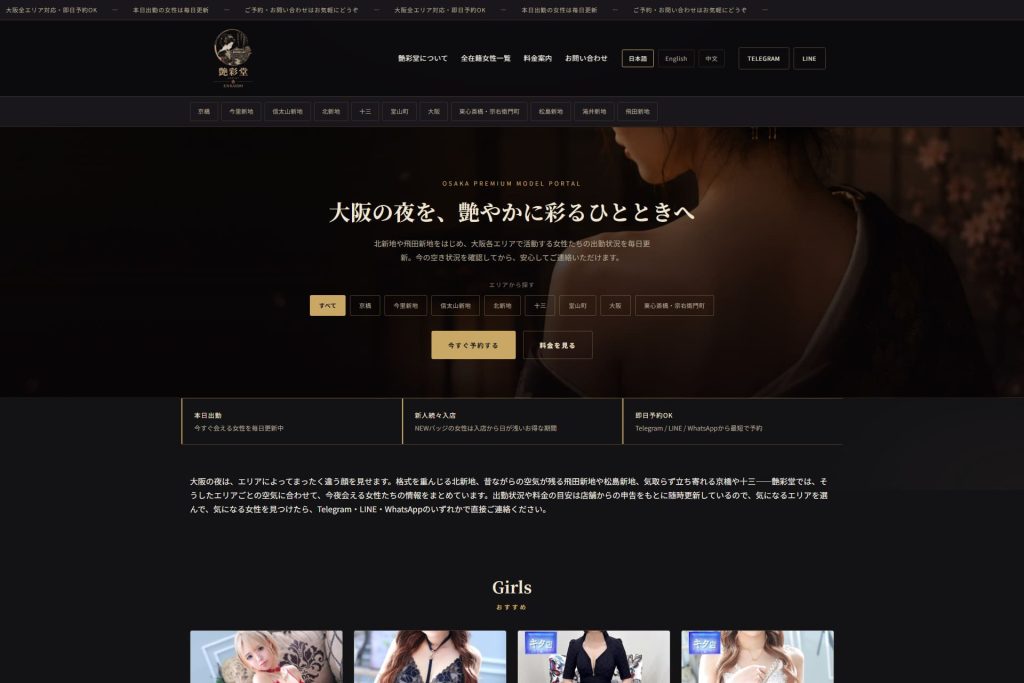
Osaka Adult Nightlife Areas
Tobita Shinchi and Shinsekai
Tobita Shinchi, in Nishinari Ward south of Shinsekai, developed from an early twentieth-century licensed quarter and remains culturally and legally complicated. Businesses are commonly presented as Japanese-style restaurants, and visitors should not improvise their own legal interpretation from that description.
Dobutsuen-mae and Shin-Imamiya provide convenient rail access, but Tobita is not a conventional tourist attraction or an extension of the restaurants around Tsutenkaku. Photography is strongly unwelcome, Japanese communication is often important, and foreign-customer policies vary by establishment. Do not photograph workers, entrances or local residents.
Matsushima Shinchi and Imazato Shinchi
Matsushima Shinchi is near Kujo Station in Osaka’s Nishi Ward. Official Osaka tourism information records its post-war relocation to the present Kujo area and notes access from the Chuo subway and Hanshin lines. It is smaller and less visitor-oriented than central Minami nightlife.
Imazato Shinchi is associated with the Shin-Imazato area of Ikuno Ward, within walking distance of Kintetsu Imazato Station. Its history is connected with Osaka’s former entertainment and geisha quarters, but today’s exact business activity should be checked from current information. Neither area should be approached on the assumption that foreign customers or non-Japanese speakers will be accepted.
Soemoncho, Doyamacho and Kitashinchi
Soemoncho contains adult-oriented premises alongside restaurants, clubs and ordinary bars. Doyamacho, east of Umeda, has small bars, entertainment venues and an established LGBTQ+ nightlife presence; not every venue is adult-oriented, and some small bars primarily serve regular customers. Kitashinchi is dominated by formal dining, lounges and hostess entertainment rather than traditional red-light streets.
These central districts are convenient, but access still varies by venue. Confirm the system, language, identification requirements and all charges before entering.
Tokyo Adult Nightlife Areas
Tokyo’s adult businesses are spread across several transport hubs. Kabukicho has the greatest visible mixture of hotels, hosted drinking, bars and adult venues. Ikebukuro has significant entertainment zones on both sides of its station. Ueno and Okachimachi combine hotels, local drinking and adult-oriented premises within a convenient eastern location.
Gotanda is useful for visitors staying in southern Tokyo or near Shinagawa, while Uguisudani’s main relevance is its concentration of short-stay hotels. Roppongi is better understood as an international club-and-bar district than a traditional Japanese adult-services centre. Ginza’s adult evening culture is led by expensive hostess clubs and lounges.
Profile-based and outcall operators may cover several of these districts. Their schedules can show who is working, but they do not guarantee that a named hotel, customer or start time is acceptable. Transport fees and dispatch times commonly change with distance.
Travellers who prefer to compare profiles, working areas, stated prices and current schedules before contacting reception can review a Tokyo-focused directory such as Tokyo Himitsu. Directory information remains a starting point: the operator must still confirm availability, language support, hotel acceptance, fees and customer eligibility.
Venue-Based vs Outcall Nightlife
At a venue-based business, the customer travels to a physical establishment and follows its reception procedure. Payment may be collected on arrival, and the business controls the rooms and entry. Confirm the address, course, nomination fee, identification and foreign-customer policy before travelling.
An outcall business dispatches a person to an approved hotel or other permitted location inside a service area. The quoted course may exclude transportation, distant-area or late-night charges. Reception may need the hotel name first and the room number after check-in. Waiting time includes preparation and travel, not only the advertised availability.
Hotel health can use a separate reception office followed by an approved nearby hotel. Profile-based services may follow any of these systems, so a profile page alone is insufficient.
Ask when payment occurs, who receives it, how cancellation works and what happens if the hotel refuses entry. Once dispatch has started, changing hotels can create transport or cancellation charges. Do not ask staff to avoid a hotel desk, use another guest’s key or misrepresent the visitor.
Language and Foreigner Acceptance
Tourist districts in both cities contain businesses comfortable with international visitors, but acceptance is establishment-specific. Some accept bookings only when a customer can speak Japanese. Others use an English form or designated messaging channel but cannot manage an English telephone call. A translated homepage may be designed for browsing rather than full customer support.
Clear communication matters for prices, timing, health rules, consent and prohibited conduct. Translation applications help with short written messages, but euphemisms and automated translations can create serious misunderstandings. Reception may decline if it cannot establish that the customer understands the rules.
State your age, nationality, language, preferred date and time, course, hotel and selected profile truthfully. A useful message is: “Hello. I am 31 and speak English only. Is this booking available at 9:00 p.m. at [hotel]? Please confirm that the hotel is accepted and tell me the complete price.” Do not use a Japanese-speaking friend to hide your inability to communicate during the appointment.
Hotels and Late-Night Transport
A business hotel may require every room occupant to register or may prohibit non-guests from reaching guest floors. City and luxury hotels can restrict visitors to public areas or disallow commercial activity even when ordinary social visitors are permitted. Love hotels are designed for couples and often offer short stays, but re-entry, advance booking and acceptance by a particular operator vary.
Confirm the hotel policy directly and ask the service separately whether it covers that property. Both answers are necessary. Serviced apartments and private rentals can also have building, host or platform rules; a self-check-in door is not automatic permission.
Osaka’s central geography gives it an advantage after midnight. Namba, Dotonbori, Soemoncho and Shinsaibashi are walkable from one another, while taxis between Minami and Umeda cover a shorter distance than many cross-Tokyo trips. This advantage disappears if the hotel is in Kyoto, Kobe or a distant Osaka suburb.
Tokyo requires district-level planning. Staying near Shinjuku is convenient for Kabukicho, but not for a late Roppongi or Ueno night. Check official operator timetables for the exact date, station, direction and connection. Last-train times change by line and day, and a final subway may arrive too late for the last connecting railway.
Costs and Spending Expectations
Osaka often feels lower-pressure because casual eating and drinking are so easy to combine. That does not make every Osaka venue inexpensive. Kitashinchi lounges, premium clubs and adult bookings can carry substantial totals. Tokyo has a wider range and a higher upper end, particularly in Ginza, Roppongi and luxury hotels.
For bars, ask about the cover or table charge, compulsory starter, drink minimum, tax, service and timed extension. At hostess venues, staff drinks, bottle charges and nomination may be separate. At adult businesses, the course can be supplemented by nomination, membership, transport, area, hotel, late-night, extension and cancellation fees.
The lowest figure on a sign is not necessarily the total for your circumstances. Before agreeing, ask: “What is the complete amount including all required fees?” When possible, retain the written reply. Confirm whether cards are accepted and whether a disclosed card-processing charge applies. Do not send deposits through an unrelated payment link or account.
Safety, Etiquette and Common Problems
Most problems begin with uncertainty rather than the identity of a whole district. An unexplained menu, a tout’s verbal promise, heavy drinking or a language gap can turn a normal decision into an expensive dispute.
- Choose venues through official websites, recognised hotel staff or independently researched addresses—not street touts.
- Read the charging system before ordering and ask how timed extensions work.
- Keep your card, telephone, passport and room key under your control.
- Do not leave drinks or valuables unattended in crowded clubs.
- Compare profile photographs and contact details across official pages; copied images and inconsistent numbers are warning signs.
- Avoid businesses with no rules, cancellation policy, service area or identifiable official contact.
- Stay sober enough to understand payment, directions and consent.
- Do not photograph staff, customers or adult-district entrances without permission.
- Payment never removes another person’s right to set boundaries or end an interaction.
- If the venue, person or bill materially differs from the agreement, stop and contact official reception rather than escalating the argument.
Call police on 110 for an immediate crime or threat. A nearby koban, or police box, can assist with lost property and non-urgent local problems. No neighbourhood should be labelled completely safe or dangerous; preparation and the choice of business matter more than broad reputations.
Which City Suits Different Travellers?
For a first evening in Japan, Osaka is often easier. Staying in Namba allows dinner, illuminated streets, informal drinks and music within walking distance. The city also suits food-focused travellers who prefer an evening to develop around several small meals rather than a single destination venue.
Dedicated club visitors should compare event calendars rather than cities. Shinsaibashi and Amerikamura offer a convenient cluster, while Tokyo provides more scenes across Shibuya, Roppongi and smaller specialist venues. The extra Tokyo choice is useful only when the traveller is willing to plan transport.
For luxury hosted nightlife, Kitashinchi and Ginza are the clearest comparison. Kitashinchi is more compact and convenient from Umeda; Ginza provides a larger premium environment. Neither is ideal for travellers who have not researched reservations and charging systems.
Casual bar hoppers may prefer Namba, Tenma or Osaka’s compact alleys. Tokyo offers excellent small-bar culture in areas such as Golden Gai and Ueno, but tiny counters can have cover charges, limited seats and a regular-customer atmosphere.
For adult nightlife, the correct category matters more than the city. Osaka offers historically distinctive districts and convenient central zones. Tokyo offers more profile-based choice and broader dispatch coverage, but its geography, hotel rules and transportation charges require closer attention. Limited Japanese speakers should prioritise confirmed communication support rather than a famous district.
Visitors with only one or two nights in Kansai gain little by rushing to Tokyo solely for nightlife. Osaka has enough variety for a complete trip. Tokyo becomes worthwhile when it is already part of the wider itinerary or when a particular club, district or entertainment format justifies the additional travel.
Planning a Nightlife Trip Between Osaka and Tokyo
The fastest scheduled Tokaido Shinkansen journeys between Shin-Osaka and Tokyo take a little over two hours, but the practical hotel-to-hotel trip is longer. Add travel from Namba or Umeda to Shin-Osaka, station navigation, boarding time and the journey from Tokyo Station to the chosen district. During designated peak periods, Nozomi services operate with reserved seating, so check JR Central’s current rules.
A sensible multi-city plan gives each city at least one unhurried evening. In Osaka, stay near Namba for Minami or near Osaka/Umeda for Kitashinchi and northern bars. In Tokyo, select the hotel after choosing the primary district: Shinjuku, Shibuya, Roppongi, Ueno or another local base.
Do not schedule a late adult or club booking on the same evening as an intercity arrival unless there is generous margin. Delayed trains, hotel check-in and unfamiliar stations make a tightly timed appointment risky. Reconfirm reservations after arriving, save the official contact number and understand the cancellation deadline.
Research each district separately. Dotonbori advice does not automatically apply to Kitashinchi, just as Kabukicho advice does not describe Ginza or Roppongi. Check the last train before drinking, retain enough money for a legitimate taxi and follow both hotel and venue rules.
Conclusion
Osaka is generally the more compact and casual nightlife city. Its central districts connect food, small bars, clubs and hotels in a way that supports an unhurried evening on foot. Tokyo offers greater scale and specialisation, from Shibuya music venues and international Roppongi bars to Ginza lounges and the many entertainment formats around Shinjuku.
The better choice depends on the actual night being planned. Accommodation, budget, language ability, preferred venue type and the final train are more useful decision factors than a simple Osaka-versus-Tokyo ranking. In either city, confirm current prices, entry rules, hotel policies and booking details rather than relying on the reputation of an entire district.